
Published October 2026
You worked hard to save $50,000. You’ve got it tucked into a high-yield savings account, earning interest and minding its business.
Love that. We appreciate a responsible girl.
But here’s the question: What is that money for?
Because money you might need next summer and money you’re setting aside for retirement have very different jobs.
And where you keep it can make a meaningful difference over time.
Let’s put some numbers to it
Imagine starting with $50,000, leaving it alone for 10 years, and reinvesting everything it earns.
Here’s what the math looks like at three hypothetical annual growth rates:
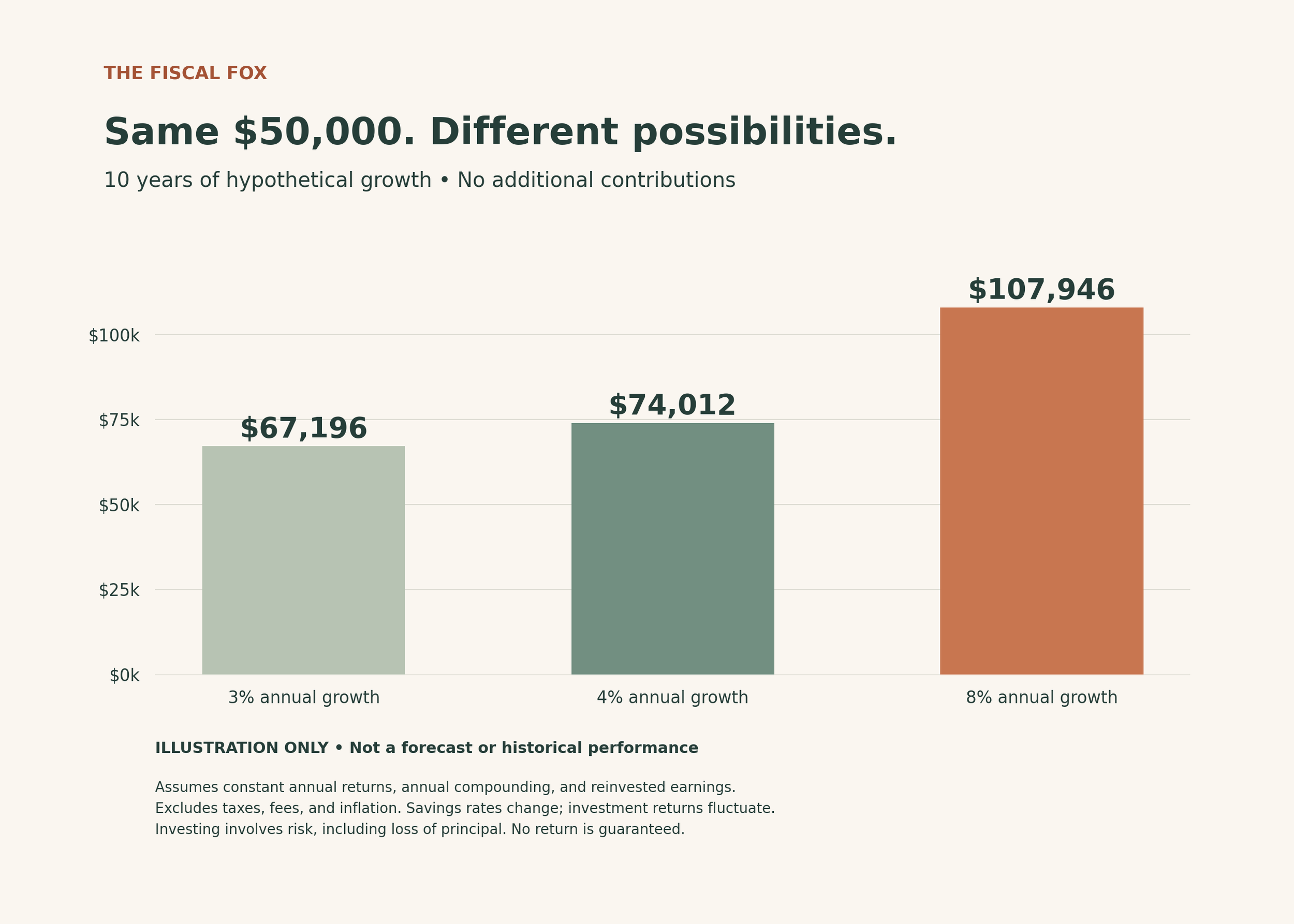
No additional contributions. Just the original money and compounded growth.
These illustrations assume a constant annual rate and annual compounding, before taxes, fees, and inflation. Savings rates change, and investment returns fluctuate. The 8% example is an illustration, not a prediction or a specific investment’s historical performance.
That gap is why it’s worth asking whether your savings account is holding money that could be working toward a longer-term goal.
Your HYSA absolutely has a job
A high-yield savings account can be a useful home for your emergency fund, an upcoming purchase, or money you need readily available.
The surprise vet bill? The roof repair? The car you’re planning to buy?
That money needs to be there when life sends the invoice.
For those dollars, access and stability matter more than chasing the highest possible return.
Investing comes with a different experience
With stocks, greater growth potential comes with the possibility of losing money.
Your balance can fall. Sometimes sharply. And it can take time to recover.
That smooth 8% calculation above? An actual investment account won’t follow that tidy little path. You may have strong years, disappointing years, and stretches that test your patience.
Having a longer timeline gives you more flexibility to weather declines, but it doesn’t eliminate risk.
That’s why investing starts with understanding when you’ll need the money, how much risk you can afford, and how you’ll respond when the balance drops.
You don’t have to choose one home for every dollar.
You can keep money available for emergencies and near-term plans while investing other dollars for future goals.
The right mix depends on your life.
Someone buying a house next year may need a very different approach from someone building a retirement fund they won’t touch for 20 years.
The question I’d start with is:
“When will I need this money, and what do I need it to do for me?”
If you were on my couch…
I’d ask you to give your savings a purpose.
Which dollars help you sleep at night?
Which are already spoken for?
Which could help give future you more choices?
You deserve to understand those decisions without needing a finance degree or pretending you know what every acronym means.
Let’s talk about what your money is for →
For educational purposes only. This material is not personalized investment advice. Investing involves risk, including possible loss of principal. Hypothetical examples do not represent actual investment results or guarantee future performance. Past performance does not guarantee future results.
